
Last Updated: September 24, 2026
Why a Doctorate, Not a Workbook, Built This Readiness Training Program
Most readiness training programs are assembled from good intentions and recycled worksheets. The Readiness for Change Institute took a different route: the program was built on a doctoral research base, developed by founder Dr. Dukes over 35+ years of study into how people actually change during major life transitions.
That distinction matters more than it sounds. When you are preparing for release, starting college, or supporting a child through either, you are not looking for motivational language. You want a program whose methods were tested, questioned, and revised before anyone handed it to you.
This guide walks through the doctoral research behind the Readiness Training program: where the readiness for change theoretical framework came from, how the study was designed, what the longitudinal data showed, and how each finding maps to a specific program module you would actually complete.
The Readiness for Change Theoretical Framework: Origins and Evolution
The readiness for change theoretical framework is a structured model for assessing where a person stands before a transition and building the specific skills that transition demands. It treats readiness as measurable and teachable, not as a personality trait you either have or lack.
From Dissertation Question to Testable Model
The research began with a practical question: why do some people thrive after a major transition while others, given identical resources, return to the same patterns? The dissertation work turned that question into testable variables, separating what could be assessed, what could be taught, and what could only be supported.
The Three Pillars: Assessment, Skill Acquisition, and Application
Every module in the program traces back to one of three pillars:
- Assessment, establishing an honest baseline of current standing, triggers, and supports
- Skill acquisition, building concrete capabilities rather than general encouragement
- Application, practicing those skills in real settings before the transition arrives
The pillars are sequential. Skipping assessment is the most common mistake programs make, and it is why participants often finish a course without changing anything.
Methodological Rigor: How the Doctoral Research Was Designed
Methodological rigor in this research meant building in the safeguards that separate a study from a survey. The design used structured instruments, defined participant criteria, and repeated measurement points rather than a single snapshot, and each of those choices was made for a reason that shows up in the program today.
The Instruments and Why They Were Chosen
The study combined three instrument types, each doing a job the others could not:
- Structured self-report scales, administered at fixed intervals, to capture how participants rated their own confidence, triggers, and support networks. Self-report is cheap and repeatable, but it is also the easiest measure to distort, which is why it was never used alone.
- Behavioral task logs, completed by participants between sessions, to record what they actually did when a real decision point arrived, not what they believed they would do. This is the measure that most often contradicted self-report, and the contradiction was treated as data rather than noise.
- Semi-structured interviews, conducted at baseline, midpoint, and follow-up, to capture the reasoning behind a decision. Interviews are slow and hard to scale, but they explain the why that a scale score can only flag.
A common pattern in this kind of research is that self-report and behavior diverge. When they did, the team went back to the interview transcripts rather than averaging the two numbers together, averaging would have hidden exactly the finding that mattered.
Participant Criteria and Sampling
Participants were not recruited as a convenience sample. Inclusion criteria required that a participant be within a defined window before a known transition, a release date, an enrollment term, a placement change, so that the 'before' and 'after' measurements bracketed an actual event rather than an arbitrary calendar gap. Participants with no identifiable transition date were excluded, because the research question was about transitions, not about readiness in general.
Attrition was tracked explicitly. Participants who dropped out were not deleted from the record; their last completed measurement was retained and their exit reason was coded. Dropping out is itself a readiness signal, and removing it would have biased every later result upward.
Coding and Analysis
Qualitative analysis used a two-pass coding approach: an initial open pass to surface themes, then a second pass against a fixed codebook so that two coders were applying the same definitions. Disagreements between coders were resolved by returning to the transcript, not by majority vote. Quantitative measures tracked skill acquisition and application over time, and the two strands were compared at each measurement point.
Validity Checks
Three checks ran throughout:
- Internal consistency across items within each scale, so a single ambiguous question could not drive a result.
- Triangulation across the three instrument types, so a finding only counted as robust if more than one source supported it.
- Member checking, in which a subset of participants reviewed summarized findings and flagged anything that did not match their experience. Several module revisions trace directly to those flags.
Where the Curriculum Mapping Began
This is also where the curriculum mapping began. Each research finding was tagged to a proposed program component, so no module exists in the program without a documented reason for being there. Findings that did not survive triangulation were not tagged to anything, and therefore did not become modules. That traceability is unusual in this field, and it is the part most competing approaches cannot replicate.
Pro Tip When you evaluate any readiness program, ask which findings were rejected during development. A program that claims every idea worked is describing marketing, not research.Measuring Readiness for Life Transitions: What the Data Actually Shows
Measuring readiness for life transitions requires tracking change over time, not scoring someone once and filing the result. The research found that single-point assessments consistently misjudged participants, often in both directions.
Longitudinal Impact Metrics vs. One-Time Assessments
Longitudinal impact metrics follow participants across months, capturing whether skills held up under real pressure. One-time assessments capture a mood, not a trajectory.
The practical consequence: a participant who scores poorly in week one may be the strongest performer by month six, and a confident week-one participant may stall once the structure is removed. Programs that measure once cannot see either pattern, which is why they cannot tell you whether they worked.
Key Takeaway Readiness is a trajectory, not a snapshot. Any program that only assesses you at the start has no way to prove it changed anything.Evidence-Based Personal Transformation Models: How This One Compares
Evidence-based personal transformation models share one trait: they can explain why each component exists. Many popular programs cannot, which is why participants often describe them as motivating in the moment and forgettable within weeks.
The model used here differs in three ways. It assesses before it teaches. It measures repeatedly rather than once. And it ties every module to a documented research finding, not to a facilitator's preference.
That structure also answers a fair objection: "I've been through programs before and nothing stuck." Programs fail to stick when they teach skills without first establishing where the participant actually is. The assessment pillar exists specifically to prevent that.
Watch Out A common mistake is choosing a program by how it feels in the first session. Motivation is the easiest thing to produce and the first thing to fade. Ask instead what the program measures and when.Curriculum Mapping: Connecting Research Findings to Program Modules
Curriculum mapping is the practice of linking each program module to a specific research finding, so the sequence reflects evidence rather than convenience. Most programs in this space describe their curriculum as a list of topics. A map is different: it is a two-column record showing, for every module, the finding that justified it and the measurement that will tell you whether it worked.
In this program, the map runs in the same order as the three pillars, assessment, skill acquisition, application, and the sequence itself is a research finding, not a formatting choice.
How the Map Is Structured
Each row of the map carries four fields:
- Module name, what the participant actually completes.
- Source finding, the specific result from the doctoral study that the module exists to address.
- Target skill, the concrete capability the module is supposed to build, stated as something observable.
- Success measure, the instrument and time point that will show whether the skill was acquired and held.
A module with an empty 'source finding' field does not ship. A module with an empty 'success measure' field ships only as a pilot, and is revised or cut before wider deployment.
A Worked Example of the Mapping Logic
Consider the sequencing decision that assessment comes before skill-building. The underlying finding was that baseline accuracy predicted later application, participants who misjudged their own starting point were the ones whose skills failed under pressure months later. That finding produced a specific module ordering rule: no skill module may be delivered before the assessment pillar is complete.
That rule has a visible consequence. A participant who arrives motivated and wants to skip straight to the application scenarios is asked to complete the baseline first. It is the single most common friction point in delivery, and it exists because the research showed that skipping it is what makes programs feel good in week one and disappear by month six.
How the Map Drives Revision
The map is not a one-time planning document. When longitudinal data showed a module underperforming, participants completing it but not applying the skill afterward, the module changed, not the measurement. The revision process works backward through the map: identify the underperforming module, re-read its source finding, and ask whether the module is teaching the finding or merely mentioning it.
Most underperforming modules fail in one of two ways. Either the target skill was written as an attitude ('understand the importance of...') instead of an observable behavior, or the success measure was a satisfaction rating rather than a skill check. Both are fixable, and both are visible only because the map forces them into writing.
Why This Matters If You Are Choosing a Program
The map is also the tool you can use on any program, not just this one. Ask three questions:
- Which specific finding does this module come from?
- What observable skill is it supposed to build?
- How and when will you measure whether I built it?
A program with a real map can answer all three. A program assembled from worksheets will answer the first with a theme, the second with an adjective, and the third with a certificate.
Key Takeaway A curriculum map is the difference between a program that can explain itself and one that can only describe itself. Ask for the map, not the syllabus.From Dissertation to Deployment: Building the Readiness Training Program
Translating a dissertation into a deployable program took a deliberate training pilot phase. Research conditions are controlled; real participants are not. The pilot tested whether the modules worked with people navigating probation, reentry, or the first year of college, and it surfaced timing problems the original study never had to solve.
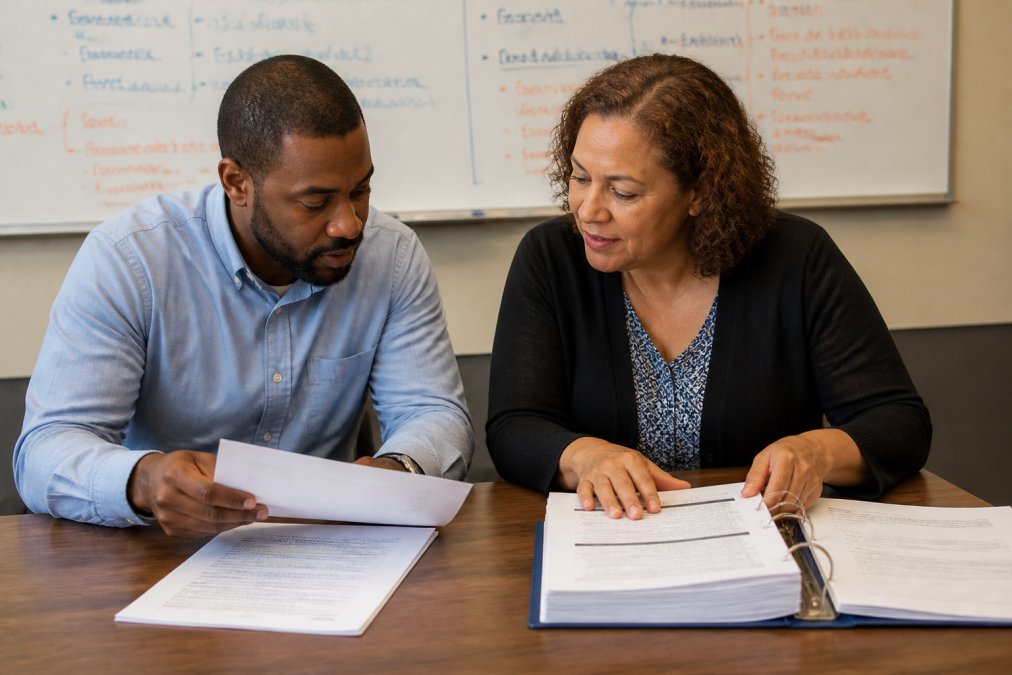
Facilitators were trained on the underlying research, not just the activities, so they could explain why a module exists when a participant pushes back. Deployment readiness meant the program could run consistently across settings, from a classroom to a one-on-one session, without losing the structure that makes it work.
What This Research Means for You: Practical Takeaways
Here is what the research base means in practice, whether you are preparing for release, starting college, or supporting someone who is.
| Your Situation | What the Research Suggests | Where to Start |
|---|---|---|
| Facing a transition with a deadline | Baseline accuracy predicts outcomes | Complete the assessment pillar first |
| Been through programs before | One-time measurement hides progress | Choose repeated check-ins over certificates |
| Need to show documented change | Longitudinal records show trajectory | Keep every assessment and application log |
| Supporting a student or family member | Skills need practice, not encouragement | Focus on application modules, not motivation |
| Unsure you are ready | Readiness is built, not innate | Start with assessment, not preparation |
The throughline across every row is the same: assess honestly, build specific skills, and practice before the transition, not after.
Transitions rarely fail because people lack motivation. They fail because no one measured where the person actually stood before asking them to move. The Readiness for Change Institute built its Readiness Training program on a doctoral research base precisely to close that gap, using a proprietary evidence-based change model, separate tracks for higher education and justice system transitions, and a consistent focus on real-world action and skill-building. Explore our Programs to see which track fits your transition.
Frequently Asked Questions
What is the theoretical framework behind readiness training?
The readiness for change theoretical framework draws from decades of doctoral research into how people actually move through major life transitions. It combines established behavioral science models with original research into the specific cognitive and environmental factors that predict whether someone will successfully reintegrate after incarceration or adjust to college life. The framework organizes readiness into three domains: assessment of current standing, skill acquisition, and real-world application. Each domain has measurable indicators, which is what separates a research-backed model from a motivational curriculum.
How does the Readiness for Change Institute apply academic research to real-world transitions?
The Institute translates doctoral-level findings into structured program modules through a process called curriculum mapping. Every exercise, discussion prompt, and assessment tool in the readiness training program traces back to a specific research finding. For example, if the research showed that peer mentorship significantly predicts program completion, the curriculum includes structured peer accountability components rather than optional add-ons. This mapping ensures participants are not just completing activities but building the specific competencies the research links to lasting change.
How does measuring readiness for life transitions differ from typical program evaluations?
Most programs measure satisfaction or completion. Measuring readiness for life transitions requires validated instruments that track change across multiple dimensions over time. The doctoral research behind this program used longitudinal study designs, following participants at multiple points after program completion rather than only at exit. This approach captures whether skills actually transferred to real-life situations, such as maintaining employment, avoiding re-arrest, or persisting through a first college semester. Those outcomes matter more than a certificate of attendance.
Why is a research-backed approach essential for long-term behavioral change?
Programs built on intuition or anecdote often produce short-term motivation without lasting change. Evidence-based personal transformation models are designed around what research shows actually predicts long-term outcomes: skill acquisition, environmental support, and iterative practice. The doctoral research behind this readiness training program identified that participants who developed specific coping and planning skills during the program were significantly more likely to maintain progress months later. Without that research foundation, you risk repeating the cycle of programs that feel good in the moment but do not stick.